THE 2007 SFAA MESSIER MARATHON, by Michael Portuesi
I hadn't done the Messier Marathon - an attempt to view all 110 Messier Objects in the same night - in some time, mostly because springtime weather in the San Francisco Bay Area has been pretty poor the past few years. But this year, almost at the last minute, I decided to do the San Francisco Amateur Astronomers Messier Marathon event at Mount Tamalpais State Park.
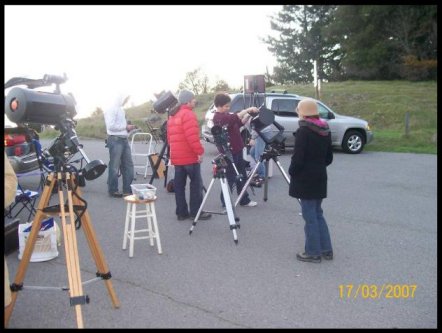
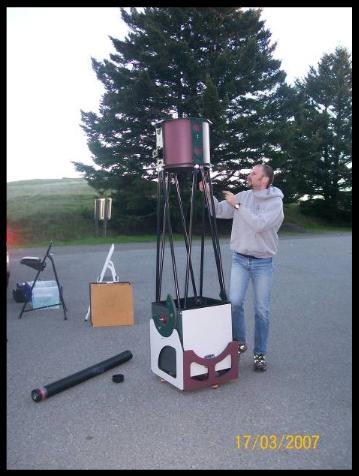
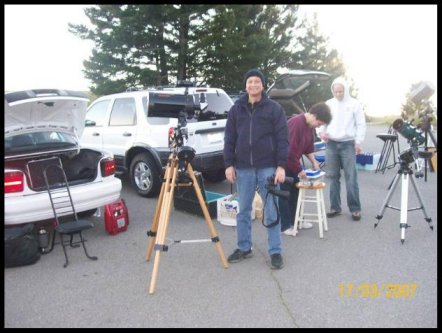
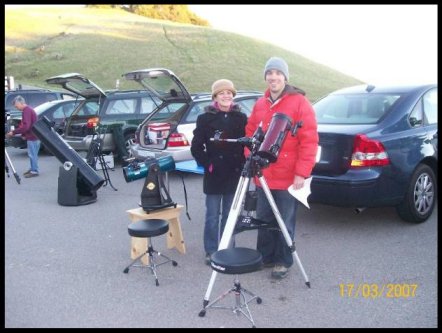
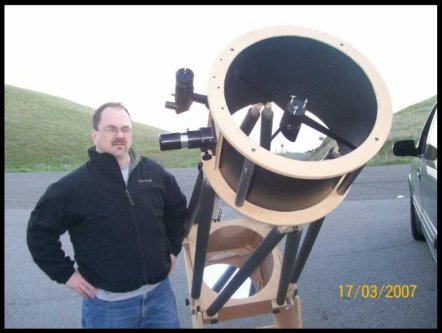
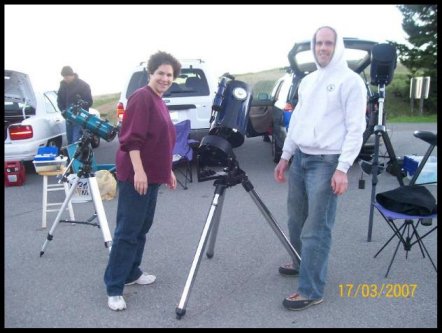
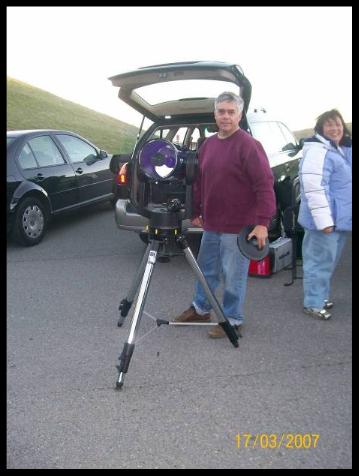
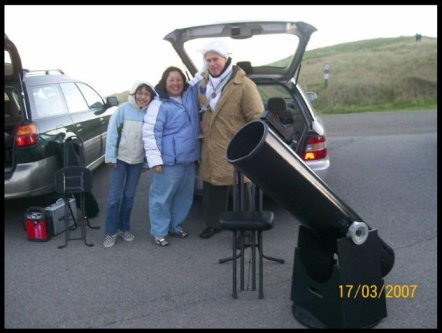
The Rock Springs parking lot, site of our usual star parties, was hosting this year's Marathon event. I brought my 15-inch F/5 LITEBOX Dobsonian reflector, and my partner Jim brought his Meade 8-inch SCT on a Losmandy mount equipped with an Argo Navis telescope computer. Both of us came prepared with Sky and Telescope's Pocket Sky Atlas for celestial navigation, as well as the February 2007 issue of Astronomy magazine featuring a special Messier pull-out section.
We were blessed with clear skies, and a good amount of fog covered the city, but not enough to really suppress the sky glow well. The temperature was only in the low 50's according to my thermometer. What made conditions a little sub-par was some wind, which was not enough to send everyone packing, but enough to put a chill into the air. I had bundled up with several layers and I felt fine, but some people froze up. The seeing was highly variable, one moment fairly decent, the next a total blur in the eyepiece. This dodgy seeing kept up through the entire evening.
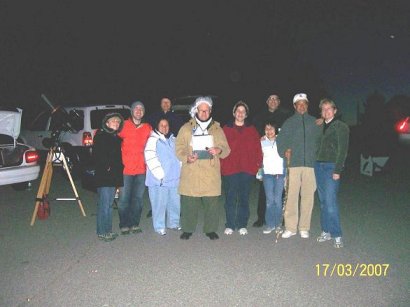
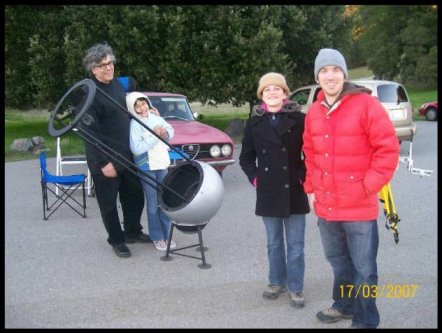
Monsieur Messier himself delivered the address for the opening ceremonies. SFAA President Ken Frank had donned a Charles Messier outfit, including a period wig, and performed his impersonation of the great 18th century comet hunter in regal style. After the words from Messier, we were off and running.
Mount Tam isn't the ideal place for the Messier Marathon. Immediately after sunset, you miss at least seven objects at the start (M33, M31, M32, M110, M52, M76) due to the northwestern tree line. I'm not a Marathon completist, and I just ignore M77 and M74 out of principle because they are a pain to find - but they were probably lost behind the trees as well.
My first successful Messier find - M103 at 8:27 pm - began a string of uninterrupted observations every few minutes, following the classic search order established by Don Macholz. Following M103, I opened with extraordinary views of the Pleiades, the Orion Nebula, as well as the open clusters M35 and M37. At my spot in the Rock Springs parking lot, a tree to the south blocked my view to the globular cluster M79. Finally, the galaxy M83 (the Southern Pinwheel Galaxy) was lost to me in the sky glow of San Francisco to the east/southeast. (Jim found it by way of his telescope computer).
I used my much-loved 32mm Erfle eyepiece, with its wide fields, to help find objects using the Pocket Sky Atlas charts. We both referred to the Astronomy magazine pullout for photos to help confirm our finds, and Jim had the extra advantage of using the computer to locate objects. I switched to 22 and 13mm Vixen Superwide eyepieces when an exceptional celestial object demanded a closer view. But mostly I stuck with my Erfle to help speed along the chase. I would lose time swapping eyepieces in what is essentially an exercise in locating objects, moreso than carefully viewing them.
We had a break in the marathon between 11 pm and midnight. After viewing all the Marathon objects possible to that point, we had to wait for the Virgo galaxies to rise in the east. Several SFAA members departed at that point, so I simply waited as cars and trucks packed up and left the mountain. We took the opportunity to enjoy some coffee and cookies as the Virgin herself rose higher into view.
At midnight, we picked up the marathon with M98, the first of the Virgo galaxies. Using the special close-up charts of the Virgo Galaxy Cluster in the Pocket Sky Atlas, I methodically stepped from M-galaxy to M-galaxy within the cluster.
At 1 am, Jim and I had made it all the way up to M57 in the search order, but M57 wasn't up above the tree line yet. We had reached another break in the marathon, where you must sit and wait an hour.
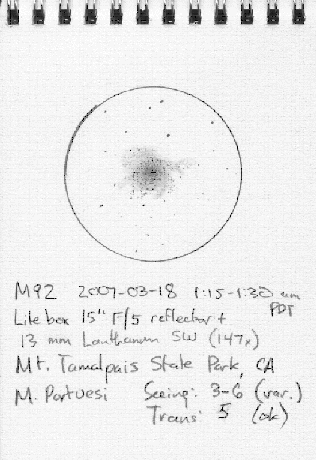
Peter Schumacher and I decided we should leave at 2 am, because we didn't know if we had access to the mountain until sunrise. So we left at 2 am, and Peter cleared out the mountain shortly after. I took a little time to make a sketch of my final object - M92 - while Jim broke his telescope down. By the time I had broken down my scope and packed, it was 2 am. M57 was right at the tree line, and fog had completely enveloped the city - but the winds had picked up. It was time to go.
All told, I caught 59 M objects (including all the M's in Virgo) before retiring for the night. I think Jim got one or two more due to where his scope was situated and the fact he had a computer to assist. I found the S&T Pocket Sky Atlas worked well for reaching every object I tried, including the galaxies in Virgo with its special close-up charts.
Monsieur Messier, he has our sincerest thanks for the marathon, and for his tasty French pastries!